Upper School STEAM
The Philosophy
The Arts & Design Department plays a vital role in helping students make sense of the world and their place within it. Through visual art, design, music, and performance, students explore how human beings communicate ideas, emotions, and experiences—often in ways that words alone cannot. Artistic and design practices teach students how ideas are formed, expressed, tested, and revised, building skills that extend far beyond the studio or stage and into every academic discipline and future pathway.
The Goal
Our courses provide structured opportunities for students to create, perform, reflect, and refine. Students learn to work through uncertainty, take creative risks, and develop confidence in their ability to shape meaning—whether through an image, a performance, a composition, or a designed solution. These experiences cultivate empathy, adaptability, and voice, helping students become thoughtful makers, collaborators, and communicators who engage the human experience with intention and care.
The Arts & Design department provides opportunities for students to practice:
- Creative Self-Expression & Exposure to the Arts: Courses that invite students to explore and communicate their ideas through artistic practice, while also engaging with artistic traditions, histories, and cultures. Instruction balances training techniques with experimentation, ensuring students both build discipline and discover their voices.
- Design Thinking: Courses that cultivate problem-solving as a creative habit of mind, emphasizing iteration, research, testing, and collaboration. Instruction balances structured frameworks with emergent learning in a sandbox environment, where experimentation and play allow students to adapt and innovate.
Note: Students may enroll in a seventh course in the Arts & Design department. Students may also carry an Arts & Design course as their sixth course.
STEAM: Engineering Design Process (F, S)
Open to: Grades 9-12
Graduation Requirement: Design
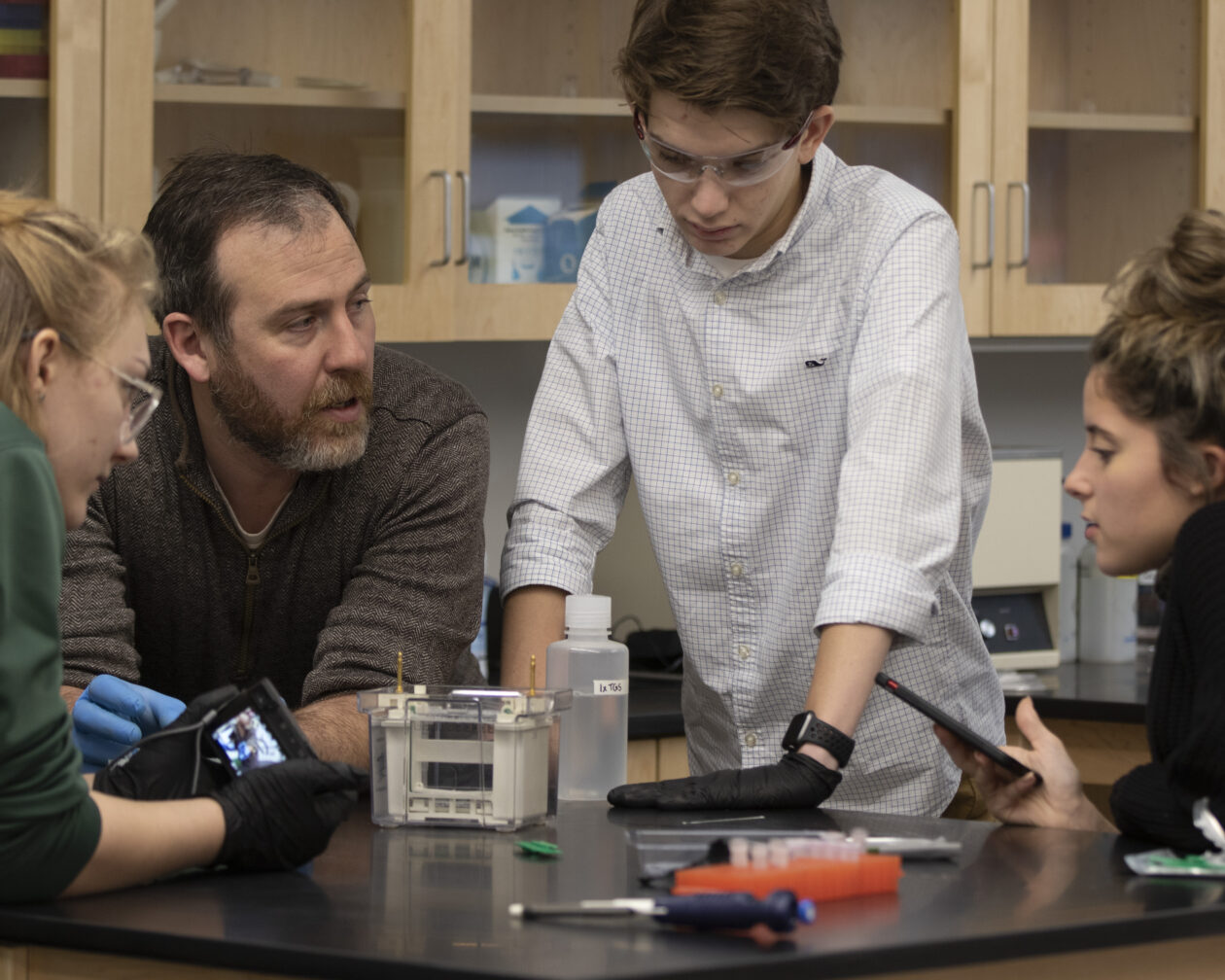
How are products developed? Why is there a new iPhone every year? What requirements need to be satisfied before an idea becomes a reality? In this course, students will be introduced to the iterative nature of the Engineering Design Process and work through it on a variety of projects. Using foundational engineering principles and hands-on practices, students will brainstorm, design, prototype, and develop solutions to real-world engineering problems. Students will engage with Derryfield’s portrait standards of critical thinking, collaboration, and problem solving as they work through projects including topics such as impact reduction, rocketry, energy conservation, and industrial engineering. This course is cross-listed with the Mathematics and Science Departments.
STEAM: 3D Design (F)
Open to: Grades 9-12
Graduation Requirement: Design
Bring your ideas to life! In this course, students will be introduced to the fundamentals of 3D computer design and utilize the shapes-based modeling software TinkerCAD to push the limits of their creativity and technical understanding. Students will utilize Derryfield’s state-of-the-art makerspace to 3D print designs and construct final projects to satisfy specific criteria. Students will engage with Derryfield’s portrait standards of critical thinking, problem solving, and creativity to come up with unique designs that solve specific problems. They will design useful tools and unique decorations as they first explore the tools of TinkerCAD and work with the 3D printers. As the term progresses, they will be challenged to design more complex projects with moving parts and specific criteria. Their term will end with a self-driven project in which students will identify their own problem and utilize 3D design to solve it. This course is cross-listed with the Mathematics and Science Departments.
STEAM: Architecture & Landscape Design (S)
Open to: Grades 9-12
Graduation Requirement: Design
This STEAM course explores how buildings and landscapes are designed to work together in functional, sustainable, and visually compelling ways. Students study major architectural styles, residential construction methods, and common landscape features while examining how climate, materials, and human use influence design decisions. Through hands-on projects, students learn how homes are framed and built to code and how outdoor spaces are planned for both form and function. The course culminates in the design and construction of a scale model home with an integrated landscape plan, as well as a collaborative, community-accessible miniature golf hole that will be built upon in future years. This course is cross-listed with the Mathematics and Science Departments.
Computer Science: Practice and Principles
Open to: Grade 9
This exposure course is designed to give all freshmen an introduction to the principles of computer programming and the impact that computational technologies have on modern society. We will work in the Python programming language and learn basic control structures and object manipulation as well as be introduced to data structures. We will also consider other topics such as cryptography and security, big data, digital humanism, virtual/alternate reality and artificial intelligence. Students will be able to transfer and apply the knowledge from this course to make better informed decisions about how to leverage technology using interdisciplinary approaches. Computer Science Practice and Principles also serves as a gateway to future coding and STEAM courses. This course is graded pass/fail and is included in LEAD programming. It is not open for separate course requests.
Applied Computer Science: Animatronics (F)
Open to: Grades 9-12
Graduation Requirement: Design
Animatronics is the art and science of creating life-like puppets and machines. In this course, students learn how to use motors and other actuators to make their creations move. Students also learn how to use sensors and an Arduino microcontroller to automate their creations. Students begin by building small interactive puppets. Students progress to making machines that walk and mimic other human and animal behaviors. No prior building, electronics, or programming experience is required. This course is cross-listed with the Mathematics and Science Departments, and counts toward a Design Requirement.
Applied Computer Science: Escape Rooms (S)
Open to: Grades 9-12
Graduation Requirement: Design
This course teaches you how to create embedded systems to construct props, locks, and puzzles for use in an escape room. Students begin the term by learning how to use devices such as buzzers, lights, sensors, relays, and switches. As the term progresses, students apply these skills to construct a variety of escape room challenges, including a rotating ambigram puzzle, a cryptographic mastermind game, and a safe-cracking challenge. Students will also learn how to program a microcontroller to control their systems and bring their puzzles to life. No prior electronics or programming experience is required. This course is cross-listed with the Mathematics and Science Departments, and counts toward a Design requirement.
Software Design with Java (Year Long)
Open to: Grades 9-12
Graduation Requirement: Design
This course offers an extensive introduction to computer programming and software design using the Java programming language. There are no prerequisites for this course, but some understanding of basic programming structures, such as the coding topics learned in the Computer Science Practice and Principles LEAD programming course, or the Computer Science elective courses, would be helpful. This course begins with the basic syntax of Java, including variables and types, simple commands, program flow and decision statements, and iterative looping structures. We then proceed to arrays and array lists, exception handling, objects and classes, interfaces, inheritance, and polymorphism, computer graphics, recursion, analysis of algorithms, sorting and searching. While learning the particulars of Java, we focus on more broad-based language and design concepts that apply to other high-level programming languages. Required: a laptop running Windows, Linux, or MacOS. This course is cross-listed with the Mathematics Department.
Advanced Topics Computer Science: Software Design with Java (Year Long)
Open to: Grades 11 & 12
Graduation Requirement: Design
Prerequisites: Permission from the teacher
Embedded in the Software Design with Java course, this advanced topic (AT) course allows students with a stronger interest in computer science to learn the Java programming language. AT students study the same topics as listed for the Software Design with Java course, but cover these topics in greater detail. AT students are also introduced to advanced programming concepts, including numerical methods and simulation, computer animation and game programming, and networking / socket programming. Students also learn practical computer skills and learn how to use modern editing, version control, and debugging tools. No specific prior knowledge is required, but having some programming experience and mathematical maturity are beneficial. AT students are assigned additional reading material and given extra programming assignments and assessments for this embedded class. Required: a laptop running Windows, Linux, or MacOS. This course is cross-listed with the Mathematics Department.